
Better Operations for a Sustainable Future
Every product delivered, every patient treated, and every shipment received is the result of a decision about how to transform resources into value.
Whether managing a national logistics network, optimizing patient flow in a hospital, or designing a closed-loop system for plastic waste, the central challenge remains constant: how to transform inputs—labor, energy, technology, and information—into sustainable goods and services through processes that are efficient, resilient, and responsible.
The Operations and Performance Management (OPM) interest group at the School of Business and Management, Institut Teknologi Bandung (SBM ITB), exists to help organizations master this transformation. We bridge the gap between high-level strategy and operational reality, ensuring that the systems organizations build today do not compromise the resources or communities of tomorrow—and that the value generated along the way is created together with, not merely delivered to, the people organizations serve.
Our Vision
Our ambition is to become a leading center of research and education in Southeast Asia for operations management, supply chain, and organizational performance. This ambition is deliberately rooted in the Indonesian industrial context rather than imported wholesale from abroad. By integrating multidisciplinary approaches—artificial intelligence, data analytics, the circular economy, and sustainability—we aim to generate knowledge that produces tangible impact for industry, public policy, and society at large.
Our Mission
Our mission is expressed through five interconnected commitments. First, we produce high-quality research relevant to the manufacturing, logistics, agribusiness supply chain, emergency service, and sustainability sectors across Indonesia and the wider ASEAN region. Second, we educate operational leaders who can adapt to digital disruption, sustainability demands, and the shifting dynamics of global supply chains. Third, we build productive global collaboration networks with leading institutions across Asia, Europe, Australia, and the Middle East. Fourth, we position ourselves as a primary reference point for operational consultation and policy guidance for state-owned enterprises (BUMN), government ministries, and the Indonesian private sector. Finally, we contribute directly to the empowerment of small and medium enterprises (SMEs), local communities, and data-driven industry through structured community service programs.
Our Position
Operations and performance management is often mistaken for a narrow, back-office function. In practice, it is the engine room of the organization. Strategy defines where an organization wants to go; operations determines whether it actually gets there. A brilliant strategy executed through weak processes produces the same result as no strategy at all.
For this reason, OPM does not treat operations as a function isolated from marketing, finance, or human resources. Instead, we view the transformation of inputs into outputs as the connective tissue running through every organizational decision—every supplier negotiated, every process designed, and every service delivered. Critically, we view value not as something an organization produces for a passive recipient, but as something produced with them. A hospital does not simply deliver care to a patient; the patient’s own participation, feedback, and needs shape how that care is designed and improved. A supplier is not merely a source of parts, but a partner in defining what quality and reliability should look like. This is the essence of value co-creation, and it sits at the heart of how OPM understands operations.
Our research therefore adopts an integrative lens, drawing on industrial engineering, management science, environmental studies, and public policy to address operational challenges that cannot be resolved from a single disciplinary viewpoint. Rather than asking how individual departments can work faster, we ask a more fundamental question: How can organizations design processes that simultaneously deliver competitive cost, quality, speed, and flexibility—while co-creating value with the suppliers, patients, and customers who depend on them?
Our Philosophy
Every organization seeks to move from its current state of performance to a better one. At OPM, we believe this journey rests on two inseparable dimensions: designing the right process, and executing that process rightly.
Designing the right process means understanding the full system before intervening in it—the suppliers, the internal workflows, the customer or patient at the end of the chain, and the environmental footprint left behind. Executing rightly means translating that understanding into disciplined operational practice: reliable quality systems, measurable performance indicators, and technology that is adopted thoughtfully rather than for its own sake.
We also believe that operational excellence cannot be separated from sustainability, nor from the people the system ultimately serves. A supply chain that is fast and cheap but environmentally destructive is not, in our view, a well-designed system—it has merely shifted its costs elsewhere. Likewise, a service that is efficient but disregards the perspective of the patient or customer it serves has optimized the wrong objective. This conviction underpins our sustained research into green supply chains, reverse logistics, and the circular economy, and it explains why value co-creation—alongside sustainability—runs through the group’s four foundational pillars rather than sitting apart from them.
Value Co-Creation: A Core Principle
Value co-creation is the idea that value is not manufactured in isolation and handed down a chain—it emerges from the interaction between an organization and its stakeholders at every point along that chain.
Within OPM’s Body of Knowledge, this principle is made explicit through the three relationship domains at the core of Supply Chain and Operations Management. The Supplier and Provider Relationship treats upstream partners as co-creators of quality and innovation, not simply vendors to be managed at arm’s length. Service Design and Process—covering inventory, scheduling, and flow, particularly in healthcare—recognizes that a well-designed process is one that is shaped by the people who move through it, not just the people who administer it. And the Patient and Customer Relationship positions the end recipient of a service or product as an active participant whose feedback, behavior, and needs continuously reshape how value is defined and delivered.
This lens carries particular weight in our healthcare operations research, where the “patient” is never a passive endpoint of a supply chain but a stakeholder whose experience actively defines what “quality care” means. It is equally visible in our SME empowerment work, where local businesses are treated not as beneficiaries of consultancy but as co-designers of the solutions that affect their own operations. By foregrounding value co-creation, OPM ensures that its research on efficiency and performance never loses sight of the people those systems are ultimately built for.
Our Body of Knowledge
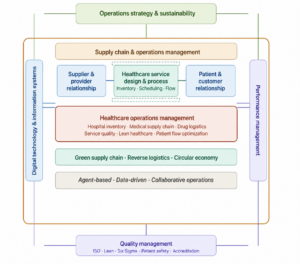
OPM’s research is organized around a core of supply chain and operations management, supported by four interconnected pillars.
Operations Strategy and Sustainability provides the overarching direction that connects every function beneath it, ensuring that operational decisions serve long-term competitiveness and environmental responsibility simultaneously. Digital technology and information systems enable data-driven decision-making across the value chain, from demand forecasting to real-time process monitoring. Performance management concerns the measurement and improvement of organizational outcomes, translating strategic intent into quantifiable results. Quality management encompasses ISO standards, Lean, Six Sigma, patient safety, and accreditation—the disciplines that ensure operational reliability at scale.
At the core, Supply Chain and Operations Management integrates the three relationship domains described above—Supplier and Provider Relationship, Service Design and Process, and Patient and Customer Relationship—which converge in three applied research areas: Healthcare Operations Management, covering hospital inventory, medical supply chains, and patient flow; Green Supply Chain, Reverse Logistics, and the Circular Economy, addressing sustainable and closed-loop practices; and Agent-Based, Data-Driven, and Collaborative Operations, the emerging methodological frontier applied across the group’s work.
Research Expertise Guide
Our faculty’s expertise spans the full breadth of the OPM Body of Knowledge.
Within Operations Strategy and Sustainability, Prof. Ir. Gatot Yudoko, M.A.Sc., Ph.D., brings cross-disciplinary experience spanning industrial engineering, transportation, environmental management, and technology policy to the group’s strategic research agenda. Dr. Yuanita Handayati, M.S.M., Director of the MBA Program and Head of the Laboratory for Educational Games, investigates agri-food supply chain resilience, food waste management, and regional food hubs, and was recognized with SBM ITB’s Teaching Award in 2024. Yuliani Dwi Lestari, S.T., M.B.A., Ph.D., advances sustainable business ecosystems with a specialized focus on halal logistics and Islamic operations. Noorhan Firdaus Pambudi, ST, MSM, M.Eng, Ph.D., whose research is supported by a grant from the Norwegian Programme for Capacity Development in Higher Education and Research for Development, examines circular economy business models and plastic waste management through system dynamics, agent-based modeling, and scenario planning; as a member of SBM ITB’s Societal Impact initiative, his work anchors the group’s green transition research.
Within Digital Technology and Information Systems, Dr.Eng. Nur Budi Mulyono, S.T., M.T., anchors the group’s digital operations and humanitarian logistics research through grants from Ristek Dikti, SBM ITB, and ITB covering logistic sharing, healthcare logistics, and humanitarian logistics, supported by a consultancy portfolio spanning BUMN, digital transformation, S&OP, OKR, and operational excellence. Akbar Adhi Utama, S.T., M.A.B., Ph.D., recipient of ITB’s Outstanding Faculty Award for Innovation at the university’s 60th anniversary, connects operations, supply chain, and emerging technology adoption research, with particular relevance to executive education and emergency medical services.
Within Performance Management, Prof. Dr. Ir. Dermawan Wibisono, M.Eng., a founder and former Dean of SBM ITB, has spent decades developing knowledge-based performance measurement systems, quality management frameworks, and corporate strategy models—authoring widely used academic texts while advising BUMN and government ministries. Desy Anisya Farmaciawaty, S.Si., MORM.Sc., Ph.D., specializes in healthcare operations, applying inventory analytics and probabilistic modeling to improve hospital service levels and pharmaceutical supply chain efficiency.
Within Quality Management and Supply Chain Collaboration, Prof. Ir. Togar Mangihut Simatupang, M.Tech., Ph.D., the group’s flagship figure for supply chain collaboration and international reputation, advances research spanning inventory systems, decision science, and creative economy logistics—recognized through the Emerald Literati Network Award (2006), the Endeavour Award (2008), and recognition as a Top Scientist in Indonesia via Google Scholar. Dr. Liane Okdinawati, S.T., M.T., examines transportation and distribution management, supply chain collaboration, and agricultural food security, supported by research grants from the Asahi Glass Foundation and Dikti.
Research Philosophy
At OPM, research begins with operational problems that matter to organizations, not with disciplinary convenience. We believe the most valuable contributions to the field emerge when scholars engage directly with the messiness of real supply chains, real hospitals, and real factory floors, rather than working exclusively with idealized models.
Our objective is twofold: to understand how operational systems actually behave, and to improve the decisions made within them. Grounded in systems thinking, we examine how suppliers, processes, and customers interact, where bottlenecks and feedback loops form, and how interventions ripple through a value chain before they are implemented at scale. This is where value co-creation becomes methodologically important: understanding a system well enough to improve it requires listening to every stakeholder who helps create value within it—not just the organization managing the process. Theory and practice inform one another continuously in this cycle; a hospital’s inventory challenge can generate a new analytical model, just as an analytical model, refined through dialogue with clinical staff and patients, can reshape how a hospital manages its inventory.
Research Approach and Methodology
Operational problems vary enormously in their structure. Some can be defined with precision—a delivery route, an inventory reorder point, a machine scheduling problem—and are well suited to quantitative optimization. Others are far messier: multiple stakeholders with conflicting priorities, ambiguous goals, and organizational politics that no equation can fully capture. OPM’s methodology is deliberately built to handle both.
For well-structured problems with clear objectives and measurable criteria, we apply hard systems approaches: operations research, probabilistic and multivariate statistical modeling, system dynamics, and agent-based modeling. These methods have supported our faculty’s work on circular economy scenario planning, hospital inventory optimization, and digital supply chain design, providing rigorous, quantifiable decision support.
For problems characterized by multiple stakeholders, competing interests, and unclear or contested definitions of “success,” we turn to soft systems approaches, most notably Soft Systems Methodology (SSM). Rather than assuming a problem is already well defined, SSM treats problem definition itself as part of the inquiry—engaging stakeholders to surface differing worldviews, negotiate a shared understanding of the situation, and design interventions that are not only technically sound but organizationally and culturally feasible. This approach is a natural companion to our commitment to value co-creation: it gives suppliers, patients, and customers an explicit voice in shaping the very systems meant to serve them, and it is particularly valuable in contexts such as healthcare service redesign or SME empowerment programs, where technical solutions alone rarely succeed without stakeholder buy-in.
We regard hard and soft systems methodologies not as competing paradigms but as complementary lenses. The choice between them—and often the blending of both within a single project—is driven by the nature of the operational problem at hand, not by methodological preference. This flexibility, combined with quantitative, qualitative, and mixed-methods empirical research, allows OPM to address the full spectrum of operational and performance challenges facing modern organizations.
From Research to Impact: Community Service
At OPM, research is not confined to academic journals. Its value is measured by the difference it makes to organizations, communities, and policy—and, in keeping with our commitment to value co-creation, that difference is built together with the communities we serve, rather than delivered to them from a distance.
This commitment is most visible in our sustained engagement with SMEs across West Java, where faculty provide operational consultancy and logistic-sharing frameworks co-designed with local business owners to strengthen industrial productivity. As the group matures, this engagement is designed to scale into formal Policy Labs, offering strategic guidance to Indonesian ministries—including Transportation, State-Owned Enterprises, and Environment and Forestry—on logistics policy and the national halal ecosystem. Looking further ahead, OPM aims to serve as a formal advisor on operational and logistics policy at the ASEAN level, including contributing to the development of Indonesia’s National Logistics Index.
Our faculty’s healthcare operations research similarly translates into direct service, supporting hospitals and pharmaceutical providers in improving inventory control and patient flow through processes shaped in dialogue with clinical staff and patients themselves. Together, these initiatives reflect our belief that operational knowledge, however rigorous, achieves its full value only when it is co-created with the people managing and experiencing real systems.
Strategic Roadmap: 2026–2035
The OPM group’s growth is structured across three phases, each building the foundation for the next.
Phase 1: Consolidation and Foundation (2026–2027) concentrates on strengthening research within the group’s three core pillars, formalizing mentoring relationships between senior and junior faculty, and establishing baseline publication and data-sharing practices. Targets for this period include ten Q1/Q2 publications, secured through grants from Kemendikbud, the SBM ITB Research Grant scheme, LPPM ITB, and early-stage LPDP funding. Key outputs include a working paper series and the formal establishment of the group’s three research pillars, alongside initial partnership mapping and MoUs with three international collaborators—TU Eindhoven, the University of Stavanger, and NTUST. Community engagement in this phase centers on SME empowerment and industrial consultancy in West Java.
Phase 2: International Acceleration (2028–2030) shifts focus toward global visibility, executive education, and international grant capture, including funding from the Asahi Foundation, JSPS, EU Horizon, and ASEAN-funded programs. The group aims to host its first international conference, establish a Center of Excellence, and cumulatively reach twenty Q1/Q2 publications. This phase also formalizes research consortiums of three or more universities per pillar, welcomes visiting professors, and launches Policy Labs advising ministries on BUMN, transportation, and environmental affairs, alongside research into the national halal ecosystem. Capacity building during this period includes formal editorial roles, international keynote engagements, and the promotion of one to two new full professors.
Phase 3: Regional Leadership (2031–2035) positions OPM as a recognized reference point across ASEAN, targeting forty cumulative Q1 publications, two to three reference books, and the hosting of a major ASEAN conference. The group aims to establish joint-PhD and dual-degree programs, sustain a permanent ASEAN research network, and serve as formal policy advisors for ASEAN operational and logistics policy, including the National Logistics Index. This final phase also anticipates the promotion of five new internationally profiled professors and a significant upgrade to the group’s laboratory infrastructure.
Looking Ahead
Operational complexity—digital disruption, sustainability pressure, and increasingly interconnected supply chains—is not a temporary condition to be managed until things return to normal. It is the permanent operating environment for organizations across Indonesia and the region.
At OPM, we believe that better operations begin with a rigorous understanding of the systems organizations depend on, paired with the discipline to execute improvements well—and the humility to recognize that value is never created alone. By continuing to integrate operations strategy, digital technology, performance measurement, and quality management—supported by both hard and soft systems methodologies, and grounded in genuine value co-creation with suppliers, patients, and customers—we aim to generate knowledge that helps organizations turn operational complexity into sustainable competitive advantage, and ultimately, into lasting societal benefit.
Members
Head: Prof. Dr. Ir. Dermawan Wibisono, M.Eng.
Akbar Adhi Utama, S.T., M.A.B., Ph.D.
Desy Anisya Farmaciawaty, S.Si., MORM.Sc., Ph.D.
Prof. Ir. Gatot Yudoko, M.A.Sc., Ph.D.
Dr. Liane Okdinawati, S.T., M.T.
Dr. Eng. Mursyid Hasan Basri, S.T., M.T.
Dr.Eng. Nur Budi Mulyono, S.T., M.T.
Noorhan Firdaus Pambudi, ST, MSM, M.Eng, Ph.D
Prof. Ir. Togar Mangihut Simatupang, M.Tech., Ph.D.
Dr. Yuanita Handayati, M.S.M.
Yuliani Dwi Lestari, S.T., M.B.A., Ph.D.