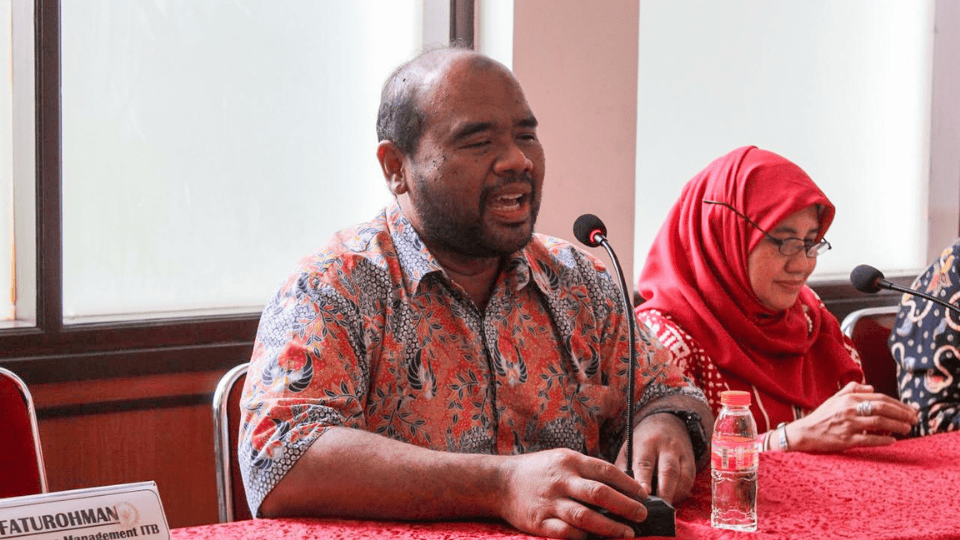
Efforts to strengthen the alignment between central and regional fiscal policies were highlighted in a Focus Group Discussion (FGD) organized by Indonesia’s Regional Representative Council (DPD RI) in Bandung on Thursday (April 16, 2026). The forum is part of the preparation process for the 2027 Macroeconomic Framework and Fiscal Policy Principles (KEM-PPKF), aimed at gathering region-based insights and enhancing the quality of national fiscal policymaking.
During the discussion, Taufik Faturrohman, an academic from the School of Business and Management, Bandung Institute of Technology (SBM ITB), emphasized the need to shift to a more risk-based, data-driven fiscal policy approach. He noted that the increasing complexity of global dynamics makes it insufficient to rely on static macroeconomic assumptions.
“Going forward, fiscal policy cannot rely solely on static macroeconomic assumptions. We need to integrate risk analysis, including scenario analysis and stress testing, to better prepare for uncertainty,” he stated during the session.
According to him, rising global uncertainty, ranging from geopolitical tensions to financial market volatility, poses significant risks to key macroeconomic indicators, including economic growth, inflation, and exchange rates. In this context, the formulation of KEM-PPKF 2027 needs to incorporate multiple scenarios rather than relying on a single baseline.
“We can no longer depend on a single baseline scenario. Fiscal policy must be prepared for multiple possible outcomes, including worst-case scenarios,” he added.
He further highlighted that fiscal policy discussions often focus excessively on numerical indicators, such as deficits and debt ratios, while overlooking the quality of policy design. In his view, fiscal effectiveness should be measured by its real impact on the economy and public welfare.
“We often focus on numbers, such as the size of spending or deficits, but what matters more is the quality of that spending. Is it targeted effectively? Does it promote long-term growth?”
He stressed the need for fiscal policy to be counter-cyclical, responsive to economic cycles, and focused on outcomes. This entails enhancing productive spending, refining subsidy effectiveness, and establishing more adaptive social protection systems.
Evaluating past fiscal policies was identified as a critical foundation for future improvements. Indonesia has demonstrated relatively strong fiscal responses during crises, but there remains room for improvement, particularly in targeting accuracy, spending efficiency, and central-regional policy integration.
“There is still room to improve, especially in targeting, efficiency, and integration between central and regional policies,” he explained.
He also stressed that fiscal integration between central and regional governments should go beyond administrative coordination and be supported by robust data systems and analytical capacity.
“Fiscal integration should not be merely administrative. It must be supported by data and analytics so that decisions truly reflect real conditions on the ground,” he said.
In closing, he emphasized that future fiscal policy should be guided by three key principles: resilience to shocks, responsiveness to public needs, and long-term sustainability.
“Fiscal policy must be resilient, responsive, and sustainable,” he concluded. The FGD is expected to generate comprehensive inputs to strengthen the formulation of the 2027 KEM-PPKF, ensuring that national fiscal policy is more adaptive, measurable, and aligned with regional needs.